 1. For my homologous trait I picked the skeleton of a frog and a skeleton of a homosapien. One of them is an amphibian and the other is a present day human being.
 2. Both of these species have a similar bone structure but with many differences between the two. The skeleton serves the same basic purpose between the two species for the most part as support and protection. But once the species separated the skeletal structure changed over time in order for both species to adapt to their surroundings.
3. The common ancestor to these two species would be one of the first species to ever have a skeleton or vertebrae because, besides the skeleton, the two species have very few similarities. I know this common ancestor had this trait because all animals with a vertebrae share that ancestor.
Analogy
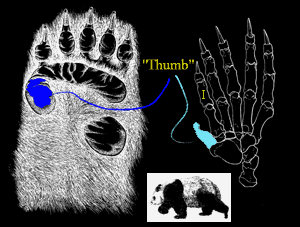 1. For my Analogous trait I chose opposable thumbs in Gorillas and Pandas. Both species exhibit this trait but don't share a common ancestor who
 does.
2. The gorillas opposable thumb is similar to that of a human being, they also serve a similar purpose. A pandas opposable thumb isn't necessarily a digit like our thumbs but rather an enlarged bone called a sesamoid bone. However it has the same purpose as an opposable thumb. The panda primarily will use the bone to grasp bamboo to eat.

3. Out of the bear family pandas are the only one to have opposable thumbs, meaning that they developed their thumbs on their own compared to a species more closely related to them then gorillas.

Hi Matthew,
ReplyDeleteWhat a great post! Very informative, yet simple. I have been struggling on how to start this project and I hope you don't mind, but I'm going to use your style! I never really thought about the Panda being the only bear with an opposable thumb or that they had opposable thumbs at all, but in context, it is obviously a very unique trait and might make one think that there was a closer relationship with the gorilla than there is. Also, I love the frog analogy with the human skeletal. When you put them side by side it is amazing how similar they are.
This is a great post! The pictures represent the words so well. Having a visual to look t while you read is the best thing to help me learn. Great job on your post! You taught me a lot. Thank you
ReplyDeleteGreat post!
ReplyDeleteVery interesting specifically the spine comparisons! I like all the photos you used to illustrate your idea very informative and interesting!
It is difficult to work with a 'structure' as broad as the entire skeleton because different parts have different functions. Some are homologs and some are just shared common traits. This caused you some problems in your description as you didn't identify the different functions and the environments in which these traits evolved. You tended to focus on their differences. And example of a homologous skeletal trait that you could have talked about was the hind limb structure. Frog hind limbs are shaped for leaping for hunting and escape predators. Human hind limbs are shaped for bipedal locomotion.
ReplyDeleteYou don't have to go back that far to find a common ancestor. Humans are mammals, who arose from reptiles, who arose from archaic amphibians. So the common ancestor for these two are the archaic amphibian who did possess the ancestral skeletal structure you are highlighting here.
Very good analogous comparison and very unique. Note that it was very important how you identified this. Because you are comparing the panda "thumb" with the gorilla thumb, these are indeed analogous because they don't share a common ancestry. But if you had compared the panda "thumb" with the comparable bone in the gorilla (I believe it is a bone in the wrist), then those structures would have been homologous structures, similar genetic origins with different structure and function. Interesting choice.
Good images.